Almanac Seed Turns a Spec File Into the App Brief
Almanac Seed Review 2026: AI-Powered App Generation from Specs
Almanac Seed lets AI build your application directly from a detailed specification, promising to revolutionize app development.

The problem it solves
Pain Points / Context Tax
Many developers and product teams face the repetitive and time-consuming task of translating detailed specifications into functional code, often involving significant boilerplate and manual effort. This process can be slow, prone to human error, and costly. Almanac Seed directly addresses this by proposing a world where the specification itself is the primary asset, and the code is automatically generated. Without Almanac Seed, iterating on design changes or building new features often means extensive manual coding, debugging, and deployment cycles.
What Almanac Seed Is
Almanac Seed offers a solution by providing an open-source framework where a markdown-based specification (SEED.md) becomes the blueprint for an AI coding agent. This agent interprets the intent described in the spec, builds the application from scratch, verifies its features, and deploys a custom instance on the user's own accounts. The core idea is to 'ship the spec, not the code,' dramatically accelerating development by automating the code generation and deployment phases.
Pricing
Almanac Seed, as an open-source specification and concept, is free to use. The Product Hunt page explicitly lists 'Free' under its pricing section. There are no subscription tiers or direct costs associated with the Almanac Seed specification itself. However, users should anticipate costs related to running their chosen AI coding agent (which might be a paid service or require computational resources) and the infrastructure/hosting for deploying the generated application.
Final Verdict
Almanac Seed represents a compelling vision for the future of software development, where the focus shifts from writing code to defining intent. By providing an open-source specification for AI-driven app generation, Almanac Seed empowers developers to build and deploy functional applications with unprecedented speed. While its effectiveness hinges on the sophistication of the AI coding agent used, the concept of 'shipping the spec, not the code' holds immense promise for increasing productivity and democratizing app creation. Almanac Seed is not just a tool; it's a paradigm shift worth exploring for anyone serious about modern development workflows.
What Almanac Seed Is
Explore Almanac Seed, an AI tool that generates full applications from a simple spec. Review covers features, use cases, pricing, and who should use it.
See it in action
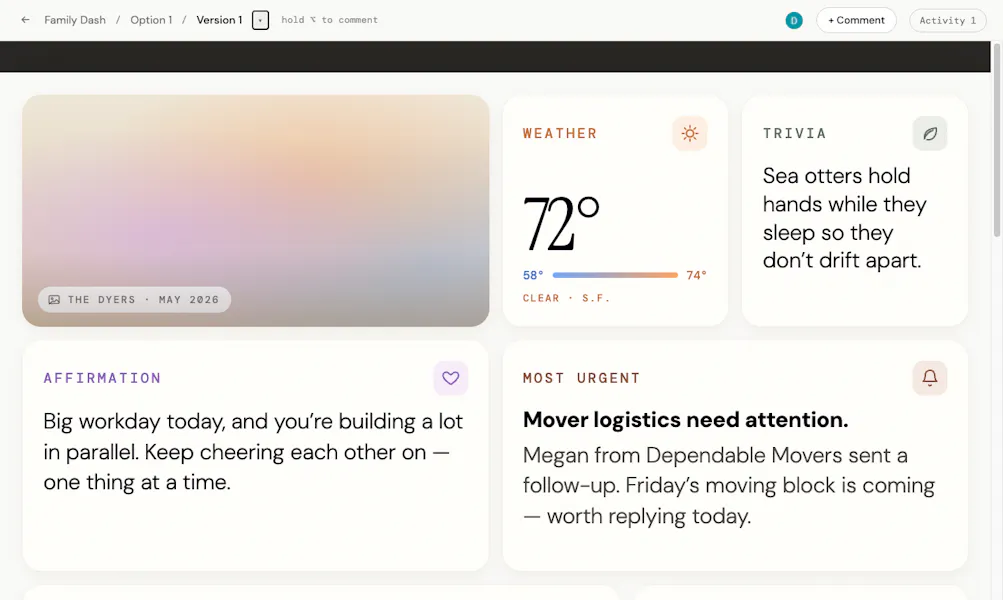
Screenshots and launch media from the official Product Hunt listing.


How It Works
- 1Define your application's intent and features in a detailed markdown file, following the open SEED format (e.g., describing a Figma-style design-review app with comments, threads, presence, and an API lane).
- 2Feed this SEED.md file into your chosen AI coding agent.
- 3The AI agent interprets the spec, generates all necessary code, and builds the complete application.
- 4The agent then verifies that every specified feature works as intended.
- 5Finally, the AI agent deploys your unique instance of the application onto your preferred hosting accounts.
Real-World Use Cases
Rapid Prototyping
Internal Tool Development
Educational Demonstrations
Privacy & Technical Details
- Almanac Seed itself is an open-source specification (SEED.md), meaning its core principles and format are transparent.
- The actual code generation and deployment happen via 'your coding agent' and 'your own instance on your accounts,' implying that data privacy and security are largely dependent on the user's chosen AI agent and hosting environment.
- The 'open SEED format' promotes interoperability and avoids vendor lock-in for the specification itself.
Pricing
Verified June 8, 2026Almanac Seed, as an open-source specification and concept, is free to use. The Product Hunt page explicitly lists 'Free' under its pricing section. There are no subscription tiers or direct costs associated with the Almanac Seed specification itself. However, users should anticipate costs related to running their chosen AI coding agent (which might be a paid service or require computational resources) and the infrastructure/hosting for deploying the generated application.
Official pricing pageHonest Pros & Cons
Pros
- • Significantly accelerates application development by automating code generation.
- • Shifts focus from writing code to defining clear intent and specifications.
- • Promotes consistency and reduces human error in coding.
- • Open-source SEED format ensures transparency and avoids vendor lock-in for the spec.
- • Full ownership of the generated code and deployed instance, as it's built on your accounts by your agent.
- • Potential for rapid iteration and prototyping.
Cons
- • Reliance on the capabilities and accuracy of the chosen AI coding agent.
- • Customization beyond the spec might require manual code modification post-generation.
- • Debugging issues in AI-generated code could be complex for intricate applications.
- • Requires users to have or integrate with a capable AI coding agent.
- • The quality and maintainability of the generated code are dependent on the AI agent's sophistication.
Comparison Table
| aspect | native | rewind | manual | almanac |
|---|---|---|---|---|
| Development Speed | Slow, requires extensive manual coding. | N/A (not a code generation tool) | Slow, requires extensive manual coding. | Extremely fast initial generation from spec. |
| Customization | Unlimited, full control. | N/A | Unlimited, full control. | High within spec; manual intervention for complex deviations. |
| Code Ownership | Full ownership. | N/A | Full ownership. | Full ownership (generated on your accounts). |
| Maintenance & Updates | Manual updates by developers. | N/A | Manual updates by developers. | Agent-driven updates from revised spec; manual for custom changes. |
| Cost Model | Developer salaries, tools, infrastructure. | N/A | Developer salaries, tools, infrastructure. | Free (spec) + AI agent/hosting costs. |
Who Should Use Almanac Seed
Almanac Seed is ideal for developers, product managers, and teams looking to rapidly prototype applications, build internal tools, or automate the generation of standard application components. It's particularly beneficial for those who prioritize speed and consistency in development and are comfortable integrating with or building their own AI coding agents. Teams with a strong focus on clear specification and intent-driven development will find Almanac Seed highly valuable.
Who Should Skip
Individuals or teams who require absolute pixel-perfect control over every line of code, or those working on highly complex, bespoke applications where AI-generated boilerplate might hinder unique optimizations, might find Almanac Seed less suitable. Also, users without access to or willingness to integrate a capable AI coding agent will not be able to leverage Almanac Seed's full potential.
Our take
Worth testing
Almanac Seed represents a compelling vision for the future of software development, where the focus shifts from writing code to defining intent. By providing an open-source specification for AI-driven app generation, Almanac Seed empowers developers to build and deploy functional applications with unprecedented speed. While its effectiveness hinges on the sophistication of the AI coding agent used, the concept of 'shipping the spec, not the code' holds immense promise for increasing productivity and democratizing app creation. Almanac Seed is not just a tool; it's a paradigm shift worth exploring for anyone serious about modern development workflows.
Current status: no tracked affiliate for Almanac Seed. This review is independent and not sponsored. We update this as programs become available (PartnerStack, Impact, etc).