Your Production Agent Keeps Lying to You. Ejentum's Harness Fixes That.
Ejentum Review 2026: A Reasoning Harness That Stops AI Agents From Drifting, Flattering, and Fabricating
679 engineered abilities injected at inference — anti-drift, anti-sycophancy, anti-fabrication

The problem it solves
Pain Points / Context Tax
Ejentum is aimed at teams who run AI agents in production and have seen the same failure modes repeat: the agent sounds confident while drifting off-spec, flatters the user instead of pushing back, fabricates details when context is thin, or slowly forgets state across a long workflow. Prompt engineering helps for a demo, but it does not scale when agents call tools, write code, and operate over dozens of turns. The Ejentum Reasoning Harness attacks those behaviors upstream instead of bolting on reactive guardrails after the fact.
What Ejentum Is
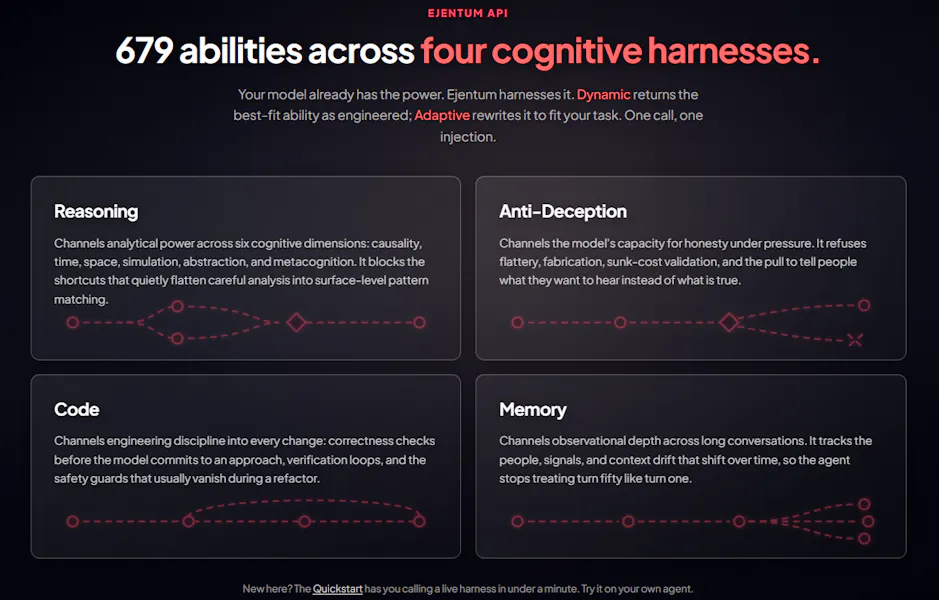
Ejentum attacks the problem upstream with a Reasoning Harness: a library of 679 engineered abilities across Reasoning, Code, Anti-Deception, and Memory layers. At runtime your agent calls the Logic API, receives a structured injection (negative gates, suppression signals, amplification signals, falsification tests), and applies it before reasoning. The promise is not "smarter model" — it is "better scaffolding so the model stops taking the shortcuts that cause drift, flattery, and fabrication." Benchmarks published on GitHub report double-digit composite quality lifts on reasoning suites, 100% pass rate gains on hard coding tasks in some conditions, 5.8% sycophancy in ELEPHANT tests, and 50% fewer stale facts in memory scenarios.
Pricing
Verified against ejentum.com/pricing on 2026-06-07. Ejentum publishes self-serve pricing in EUR with a no-card free trial and two paid tiers. Free trial: €0 for 30 days, 1,000 dynamic calls, all four harnesses, dynamic modes only (no adaptive), no payment method required — register at ejentum.com/auth/register. Go: €5/month with 1,000 dynamic + 250 adaptive calls/month, full access to Reasoning, Code, Anti-Deception, and Memory harnesses (679 abilities). Super: €25/month with 5,000 dynamic + 1,500 adaptive calls/month for production volume. Dynamic calls return the best-matching cognitive operation; adaptive calls rewrite the approach for your task shape (separate monthly pool). When limits are hit you get HTTP 429 with upgrade link; adaptive exhaustion falls back to dynamic with a response header flag. Burst rate: 100 req/min on paid tiers. Pools reset on a 30-day rolling cycle. Higher volume: info@ejentum.com.
Final Verdict
Ejentum is one of the more serious "agent reliability" bets of 2026 — closer to infrastructure than yet another AI wrapper. The published benchmark depth (including negative results) is the differentiator. If you run agents in production, it is worth a structured pilot on one high-value workflow. If you are browsing Product Hunt for a simple productivity app, this is not that — but for the agent-builder audience, the problem-solution fit is sharp and the review gap in search is wide open.
What Ejentum Is
Ejentum is a Reasoning Harness for agentic AI that injects engineered cognitive operations at inference time. Honest review: drift/sycophancy/hallucination pain, benchmark results, pricing, pros/cons, and who should use it.
See it in action
Screenshots and launch media from the official Product Hunt listing.


How It Works
- 1Your agent receives a task (research, coding, multi-step workflow, or conversational coaching).
- 2Before reasoning, the agent calls Ejentum's Logic API (POST /logicv1/) with the task summary and selects a harness mode: reasoning, code, anti-deception, or memory.
- 3Ejentum returns an injection payload: failure patterns to avoid, execution topology, suppression/amplification signals, and a falsification test.
- 4The agent applies the injection to its context and proceeds — mirroring real deployment where retrieval variance is real, not simulated.
- 5You evaluate outcomes with your own eval loop; Ejentum publishes blind benchmark protocols for comparison against baseline runs.
Real-World Use Cases
Production agent workflows
Code agent hardening
Customer-facing copilots
Long-running memory agents
Privacy & Technical Details
- API-based injection at inference time — your agent stack calls Ejentum; review their docs for data handling on task summaries sent to /logicv1/.
- Benchmarks use agent-native execution: agents call the production Logic API via tool use, not offline prompt stuffing.
- Cross-model validation includes GPT-4o and Claude families in published suites — mechanism is positioned as model-agnostic scaffolding.
- Negative findings are reported publicly (correctness dips, domain regressions) — unusual transparency for an early infra product.
- Caveat: this is infrastructure, not a consumer app — you need engineering time to integrate and measure ROI on your own workloads.
Pricing
Verified June 8, 202630 days
- • 1,000 dynamic calls
- • Dynamic modes only (no adaptive)
- • All four harnesses unlocked
- • No payment method required
per month
- • 1,000 dynamic calls/month
- • 250 adaptive calls/month
- • 4 harnesses · 679 cognitive abilities
- • Same API surface as Super
per month
- • 5,000 dynamic calls/month
- • 1,500 adaptive calls/month
- • Production volume for teams outgrowing Go
- • Upgrade anytime from dashboard
Verified against ejentum.com/pricing on 2026-06-07. Ejentum publishes self-serve pricing in EUR with a no-card free trial and two paid tiers. Free trial: €0 for 30 days, 1,000 dynamic calls, all four harnesses, dynamic modes only (no adaptive), no payment method required — register at ejentum.com/auth/register. Go: €5/month with 1,000 dynamic + 250 adaptive calls/month, full access to Reasoning, Code, Anti-Deception, and Memory harnesses (679 abilities). Super: €25/month with 5,000 dynamic + 1,500 adaptive calls/month for production volume. Dynamic calls return the best-matching cognitive operation; adaptive calls rewrite the approach for your task shape (separate monthly pool). When limits are hit you get HTTP 429 with upgrade link; adaptive exhaustion falls back to dynamic with a response header flag. Burst rate: 100 req/min on paid tiers. Pools reset on a 30-day rolling cycle. Higher volume: info@ejentum.com.
Official pricing pageHonest Pros & Cons
Pros
- • Directly targets the highest-friction agent failures: drift, sycophancy, hallucination, and memory decay.
- • Published benchmark methodology with blind evaluation and negative findings — builds trust for technical buyers.
- • Four harness layers (Reasoning, Code, Anti-Deception, Memory) map cleanly to real production concerns.
- • Reported hard results on coding correctness (e.g., LiveCodeBench Hard improvements in published data) matter to engineering leaders.
- • Transparent self-serve pricing with a no-card 30-day trial — low friction for agent builders to pilot on real workloads.
- • Thin independent review competition today — strong SEO window for "Ejentum review" and "reasoning harness" queries.
Cons
- • Integration complexity: not a plug-and-play Mac app — requires agent architecture that can call an external Logic API.
- • Benchmarks are vendor-published; you should replicate on your own tasks before trusting headline deltas.
- • EUR-only list prices — USD teams should factor FX; enterprise volume still requires emailing info@ejentum.com.
- • Name/category education needed: "reasoning harness" is new vocabulary for many buyers.
- • Not a fit for casual ChatGPT users — value shows up in multi-step agent systems.
Comparison Table
| aspect | ejentum | native | rewind | manual |
|---|---|---|---|---|
| Problem focus | Inference-time cognitive scaffolding for agent failure modes | Better prompts + model memory features | Capture everything, search later | Custom evals and human review gates |
| Best for | Teams shipping agentic workflows in production | General chat and light automation | Personal recall and life logging | Low-volume, high-stakes tasks |
| Setup effort | Engineering integration (API + eval loop) | Low | Install app, grant permissions | Very high ongoing labor |
| Evidence style | Published multi-benchmark reports + paper | Vendor feature announcements | User testimonials + search UX | Your own notes and judgment |
Who Should Use Ejentum
You are building or operating AI agents (coding agents, research agents, customer copilots) and losing time to drift, flattery, or silent hallucinations across multi-step runs. You have engineers who can integrate an API and run evals. You want infrastructure-level guardrails rather than another prompt template library.
Who Should Skip
You only use chatbots for one-shot questions. You have no agent loop or tool-use architecture. You need a GUI product with zero API integration work. You are not willing to validate vendor benchmarks on your own workloads.
Our take
Worth testing
Ejentum is one of the more serious "agent reliability" bets of 2026 — closer to infrastructure than yet another AI wrapper. The published benchmark depth (including negative results) is the differentiator. If you run agents in production, it is worth a structured pilot on one high-value workflow. If you are browsing Product Hunt for a simple productivity app, this is not that — but for the agent-builder audience, the problem-solution fit is sharp and the review gap in search is wide open.
Current status: no tracked affiliate for Ejentum. This review is independent and not sponsored. We update this as programs become available (PartnerStack, Impact, etc).