Clear the Air: How Hush Delivers Pristine Audio for AI Conversations
Hush Review 2026: Open-Source Noise Suppression for Voice AI Agents
Hush offers open-source, real-time noise suppression, ensuring your voice AI agents hear and respond with crystal clarity.

The problem it solves
Pain Points / Context Tax
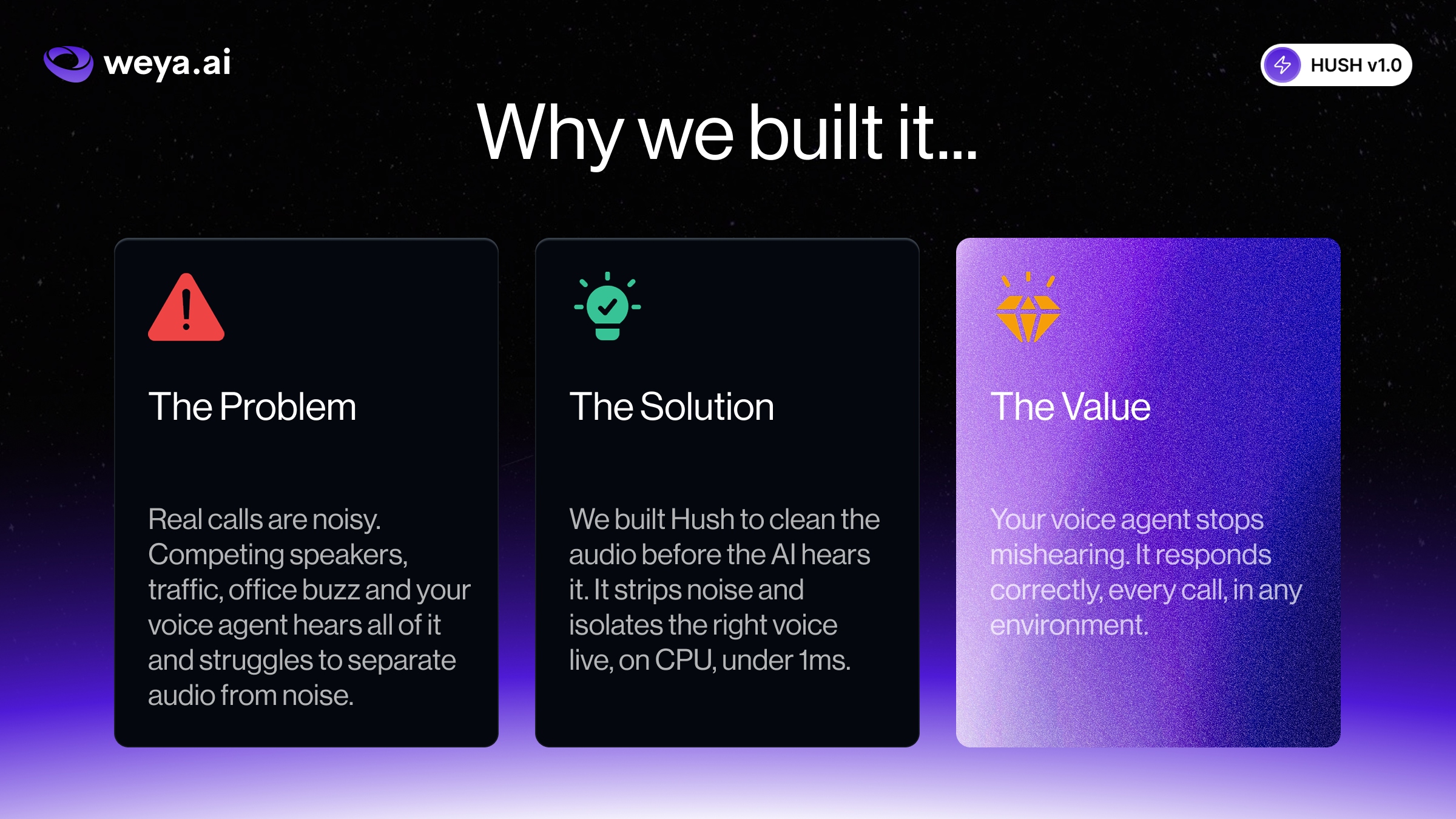
In the rapidly evolving landscape of voice AI, a significant challenge remains: background noise. Voice AI agents often struggle to accurately interpret user commands or questions when faced with distractions like traffic, office chatter, or other voices. This leads to misinterpretations, frustrating user experiences, and ultimately, reduced operational efficiency. Without effective noise suppression, the promise of seamless AI-human interaction is undermined, forcing developers to build complex, often imperfect, workarounds or accept suboptimal performance. Hush directly addresses this critical pain point, offering a specialized solution.
What Hush Is
Hush provides a robust, open-source framework for real-time noise suppression, tailored for voice AI agent infrastructure. By integrating Hush, developers can equip their AI agents with the ability to filter out unwanted audio elements, such as competing voices, general background noise, and various forms of audio interference. This results in a significantly clearer audio input for the AI, improving speech-to-text accuracy, reducing latency, and enabling more natural and effective conversations between users and AI agents. Hush empowers AI agents to focus on what truly matters: the user's voice.
Pricing
Hush is an open-source project, making it entirely free to use and integrate. There are no subscription tiers, usage limits, or hidden costs associated with its core functionality. This model allows developers and organizations to leverage powerful noise suppression capabilities without financial barriers, fostering widespread adoption and customization within the voice AI ecosystem.
Final Verdict
Hush stands out as a highly valuable, open-source tool for anyone serious about deploying robust voice AI agents. Its dedicated focus on delivering pristine audio input directly addresses a core challenge in AI-human interaction. While it requires technical integration, the benefits of transparency, customization, and zero cost make Hush an compelling choice for developers aiming to elevate the performance and reliability of their voice AI applications.
What people are saying
Verbatim quotes from Product Hunt — not paraphrased by us.
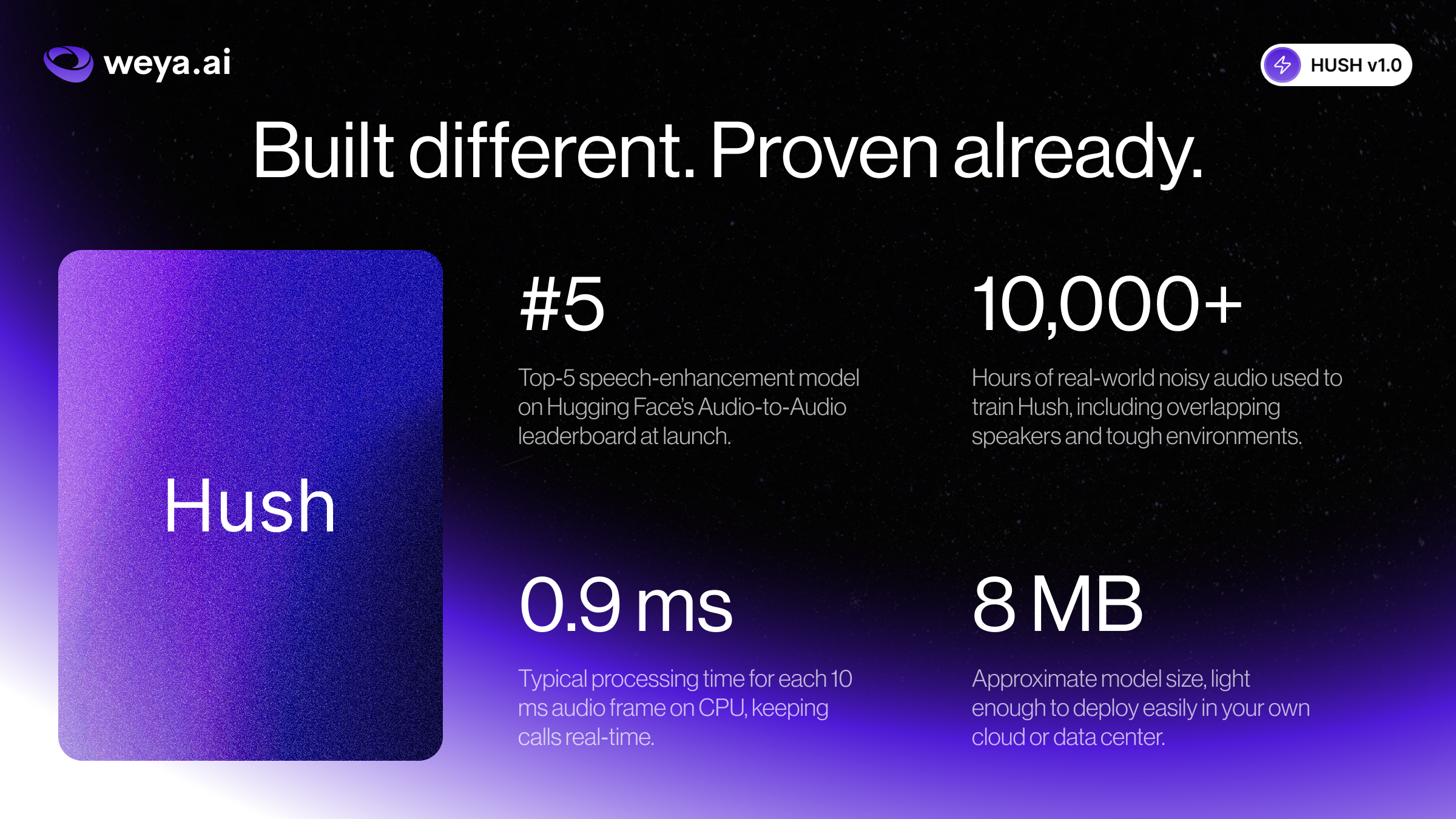
“Sub-1ms on CPU is the claim that matters most here and also the one I'd want stress-tested. What's the degradation curve? Does it hold at 1ms with a single stream, and what happens at 10 or 50 concurrent calls on commodity hardware? That's the production reality for anyone running voice agents at scale. The open-source angle is smart for adoption but the real question is where the commercial model sits. Apache 2.0 gets you into production stacks fast. What's the wedge that converts users to paying customers? On the commercial question: Hush is genuinely open source, no "open core" catch. The m”
What Hush Is
Explore Hush, the open-source noise suppression tool designed to enhance voice AI agent interactions by eliminating background noise and interference.
See it in action
Screenshots and launch media from the official Product Hunt listing.

How It Works
- 1Audio Capture: Hush intercepts the raw audio stream from the user's microphone or communication channel.
- 2Real-time Processing: Utilizing advanced algorithms, Hush analyzes the audio in real-time to identify and differentiate between desired speech and various forms of noise (background, competing voices, interference).
- 3Noise Suppression: Unwanted audio elements are intelligently filtered out, leaving a cleaner, more focused speech signal.
- 4Clean Audio Output: The processed, noise-suppressed audio is then fed directly into the voice AI agent's speech-to-text engine or natural language processing pipeline.
- 5Enhanced AI Interaction: The AI agent receives a pristine audio input, leading to higher accuracy in transcription and understanding, and ultimately, more effective and fluid conversations.
Real-World Use Cases
Customer Service Bots
Voice Assistants in Smart Homes
AI-powered Meeting Transcribers
In-Car Voice Control
Privacy & Technical Details
- Open-source nature allows for full transparency and auditability of the code.
- Designed for real-time, on-device or edge processing, potentially reducing reliance on cloud-based audio processing for sensitive data.
- Focuses on audio signal processing, not content analysis or storage, minimizing privacy concerns related to speech content.
- Integration flexibility due to its open-source status, allowing developers to tailor its deployment to specific privacy requirements.
Pricing
Verified July 1, 2026Hush is an open-source project, making it entirely free to use and integrate. There are no subscription tiers, usage limits, or hidden costs associated with its core functionality. This model allows developers and organizations to leverage powerful noise suppression capabilities without financial barriers, fostering widespread adoption and customization within the voice AI ecosystem.
Official pricing pageHonest Pros & Cons
Pros
- • Open-Source & Free: No licensing costs, full code transparency, and community-driven development.
- • Targeted for Voice AI: Specifically designed to optimize audio input for AI agents, improving accuracy.
- • Real-time Performance: Crucial for interactive voice applications where latency is a critical factor.
- • Removes Competing Voices: Addresses a common and difficult challenge in multi-speaker environments.
- • Integration Flexibility: Being open-source, it can be adapted and integrated into various existing infrastructures.
Cons
- • Requires Technical Integration: Not a plug-and-play end-user application; needs developer expertise.
- • No Commercial Support: As an open-source project, official dedicated commercial support might be limited or community-driven.
- • Performance Varies by Implementation: Effectiveness can depend on how well it's integrated and configured for specific use cases.
- • Limited to Audio Input: Focuses solely on noise suppression, not other aspects of AI agent performance or audio output.
Comparison Table
| aspect | native | rewind | manual | hush |
|---|---|---|---|---|
| Target Audience | General users (e.g., video calls) | Individual productivity/memory | Human agents in call centers | Voice AI agent developers |
| Integration | Built-in OS feature or app setting | Standalone app or browser extension | Human ear + manual filtering/clarification | Open-source library for AI infrastructure |
| Real-time Processing | Yes, for human communication | Often post-processing or local recording | Yes, human brain processes in real-time | Yes, optimized for AI agent input |
| Focus | Human-to-human communication | Personal information capture/recall | Human understanding and problem-solving | AI agent input clarity (speech-to-text) |
| Competing Voices | Varies, often less effective | Not primary focus, may record all audio | Human agent can discern/ask for clarification | Explicitly targets and removes |
| Cost | Included with OS/platform | Varies (free to paid subscriptions) | Labor cost of human agents | Free (open-source) |
Who Should Use Hush
Developers and organizations building voice AI agents, particularly those operating in noisy environments or requiring high accuracy for speech-to-text. It's ideal for teams looking for a customizable, transparent, and cost-effective solution to enhance their AI's audio input capabilities. Teams with in-house development resources who can integrate and potentially contribute to an open-source project will benefit most from Hush.
Who Should Skip
End-users looking for a simple, plug-and-play noise suppression app for personal calls or meetings (e.g., Zoom, Teams). Individuals or small businesses without developer resources to integrate an open-source library will find Hush too complex. Those who need a complete, managed voice AI platform rather than a component for their existing infrastructure should look elsewhere.
Our take
Worth testing
Hush stands out as a highly valuable, open-source tool for anyone serious about deploying robust voice AI agents. Its dedicated focus on delivering pristine audio input directly addresses a core challenge in AI-human interaction. While it requires technical integration, the benefits of transparency, customization, and zero cost make Hush an compelling choice for developers aiming to elevate the performance and reliability of their voice AI applications.
Current status: no tracked affiliate for Hush. This review is independent and not sponsored. We update this as programs become available (PartnerStack, Impact, etc).