Verol Transforms AI Responses into Verified, Trustworthy Information
Verol Review 2026: Real-Time AI Hallucination & Fact Checker
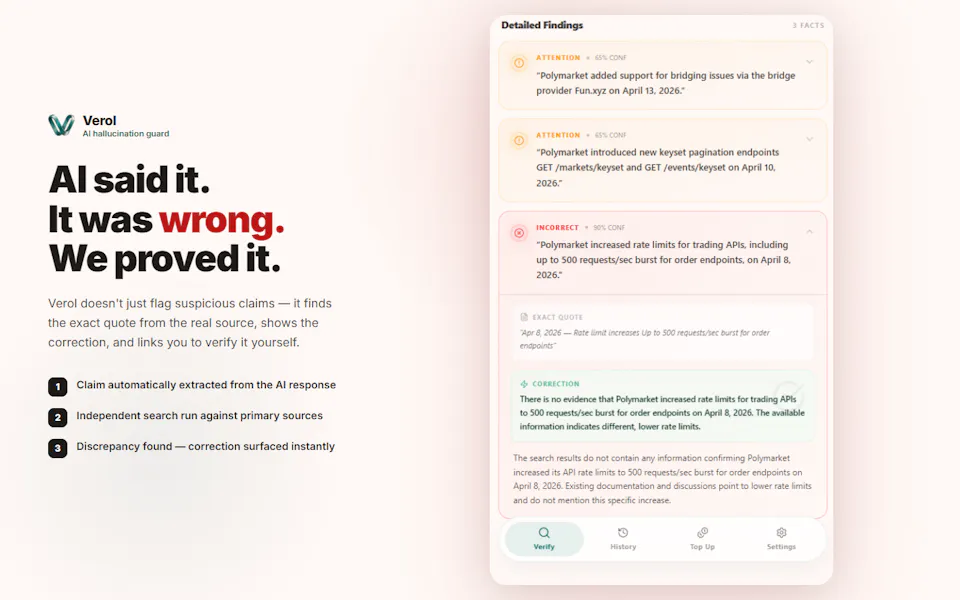
Verol is a real-time Chrome extension that automatically fact-checks AI outputs, highlighting hallucinations and confirming verified claims directly in your chat.

The problem it solves
Pain Points / Context Tax
The proliferation of AI-generated content has brought with it a significant challenge: AI hallucinations. These fabricated facts, non-existent sources, and confidently incorrect statements can lead to wasted time, reputational damage, and misinformed decisions. Professionals across various fields, from developers to marketers and researchers, constantly grapple with the unreliability of large language models. Verol directly addresses this critical issue, offering a solution to the inherent inaccuracies that plague even the most advanced AI assistants.
What Verol Is
Verol provides a crucial layer of real-time fact-checking, acting as an automated guardian against AI-generated misinformation. Instead of manually cross-referencing every AI claim, Verol seamlessly integrates into your workflow, silently monitoring and validating information as it appears. Its proprietary engine breaks down AI responses into distinct factual claims, then cross-references them against trusted live sources, providing instant visual feedback on accuracy. This dedicated verification architecture ensures that users can leverage AI's power without falling victim to its factual shortcomings.
Pricing
Verol offers a tiered pricing structure, starting with a Free plan. The Free plan provides a limited number of verifications and claim extractions per month. For more extensive use, the Starter plan is available at $4.99 per month, offering increased limits on verifications and claim extractions. The Extended plan, priced at $29.99 per month, provides the highest capacity for verifications and claim extractions. Specific numerical limits for each tier are not detailed on the public pricing section but are managed within the extension itself. All plans are billed monthly, and upgrades are handled directly within the Verol browser extension.
Final Verdict
Verol stands out as a critical tool in the age of pervasive AI, directly addressing the persistent challenge of hallucinations. Its real-time, inline fact-checking capability, coupled with a strong commitment to user privacy through its zero-knowledge architecture, makes it a highly valuable asset for anyone using AI for professional or critical tasks. While specific pricing limits could be more transparent, the core value proposition of transforming unreliable AI outputs into verified, trustworthy information is compelling. Verol is a significant step forward in making AI more dependable.
What people are saying
Verbatim quotes from Product Hunt — not paraphrased by us.
“This is exactly what I needed! AI is great but the hallucinations are a real problem. Verol solves it seamlessly.”
“The real-time verification directly in the chat is a game-changer. No more switching tabs to double-check facts.”
“Finally, a tool that takes AI accuracy seriously. Verol's zero-knowledge architecture is a huge plus for privacy-conscious users.”
What Verol Is
Verol is a real-time AI hallucination and fact-checker Chrome extension. It verifies AI outputs directly in your browser, ensuring accuracy and preventing misinformation.
See it in action
Screenshots and launch media from the official Product Hunt listing.


How It Works
- 1Semantic Extraction: A lightweight LLM parses the incoming AI stream to isolate hard, verifiable claims (dates, metrics, APIs).
- 2Targeted Grounding: An orchestrator identifies the claim type and spins up parallel search agents targeting specific verticals (GitHub, Official Docs, News, Live Data).
- 3Cross-Reference: A powerful heavyweight LLM compares the original AI's claim against retrieved search context, scoring it for truthfulness and generating corrections.
- 4UI Injection: The verdict is piped back into your browser locally and rendered as red/green annotations inside your AI chat using isolated Shadow DOM boundaries.
Real-World Use Cases
Ensuring Code Accuracy for Developers
Validating Market Data for Marketers
Preventing Fabricated Information for Researchers and Writers
Auditing AI Reports for Business Analysts
Privacy & Technical Details
- No Server DB for Prompts: Verification payload is sent to stateless edge functions, processed in RAM, and immediately discarded.
- 100% Local History: Entire verification history is stored exclusively in the browser's secure IndexedDB.
- Zero-Knowledge Architecture: Verol cannot see your chat history or personal data.
Pricing
Verol offers a tiered pricing structure, starting with a Free plan. The Free plan provides a limited number of verifications and claim extractions per month. For more extensive use, the Starter plan is available at $4.99 per month, offering increased limits on verifications and claim extractions. The Extended plan, priced at $29.99 per month, provides the highest capacity for verifications and claim extractions. Specific numerical limits for each tier are not detailed on the public pricing section but are managed within the extension itself. All plans are billed monthly, and upgrades are handled directly within the Verol browser extension.
Honest Pros & Cons
Pros
- • Real-time, inline hallucination detection and fact-checking directly in AI chat interfaces.
- • Seamless integration with major AI platforms via a user-friendly Chrome extension.
- • Zero-knowledge architecture ensures user privacy by not storing prompts or history on external servers.
- • Goes beyond simple citation checking by validating factual claims against live, trusted sources.
- • Addresses specific risks for various professions, including developers, marketers, and researchers.
- • Provides clear visual cues (red underlines, green badges) for immediate feedback on accuracy.
- • A free tier is available for users to test its capabilities before committing.
Cons
- • Specific numerical limits for 'Verifications / mo' and 'Claim Extractions / mo' for paid tiers are not transparently listed on the website.
- • Relies on a browser extension, limiting its use to supported browsers and potentially excluding desktop AI applications.
- • The effectiveness hinges on the proprietary 'semantic claim extraction' and the quality/breadth of its 'trusted sources'.
- • As with any automated system, there is a potential for occasional false positives or negatives in verification.
- • Requires an active internet connection for its real-time verification processes.
Comparison Table
| aspect | verol | native | rewind | manual |
|---|---|---|---|---|
| Fact-Checking Method | Real-time, inline semantic claim extraction & cross-referencing against live, targeted sources (GitHub, PyPI, news, live data). | Limited internal search (if any), often relies on training data, prone to hallucinations. | Records AI output but offers no inherent fact-checking. | User manually copies claims, pastes into search engine, evaluates multiple sources. |
| Speed & Integration | Instant, automatic, visual feedback (red/green) directly in AI chat. No tab switching. | Requires manual prompting ("Are you sure?", "Cite sources"). No real-time validation. | Records passively; separate process needed for verification. | Slow, disruptive, requires constant context switching between AI and search. |
| Privacy | Zero-knowledge architecture: no server storage of prompts/history, local storage only. | Varies by platform; often logs prompts for model improvement, privacy policies differ. | Stores all browser activity locally or in the cloud, depending on configuration. | User's search history is logged by search engines. |
| Specificity | Targeted verification for code, numbers, dates, academic papers against specific registries/databases. | Generic search queries, easily satisfied by SEO spam; struggles with precise, real-time data. | Not applicable to verification. | User must manually refine search queries for specific data types, which can be time-consuming. |
| Cost | Free tier, then $4.99-$29.99/month for more capacity. | Free tiers available, paid tiers for advanced features/higher limits. | Varies; some free, some subscription-based (e.g., Rewind AI). | Free, but incurs significant time cost. |
Who Should Use Verol
Verol is ideal for professionals who rely on AI for critical tasks and cannot afford factual errors. This includes software developers needing to verify API calls and package versions, marketers validating statistics and market data, researchers and academics ensuring the accuracy of citations and historical facts, and business analysts auditing AI-generated reports. Anyone who uses AI assistants frequently and values accuracy and efficiency will find Verol an indispensable tool.
Who Should Skip
Users who only engage with AI for creative writing, brainstorming, or casual conversations where factual accuracy is not paramount might find Verol unnecessary. Those who prefer to manually verify information or are uncomfortable with browser extensions that interact with their AI chat interfaces may also choose to skip Verol. Additionally, users who primarily interact with AI via desktop applications or platforms not supported by a Chrome extension would not benefit.
Our take
Worth testing
Verol stands out as a critical tool in the age of pervasive AI, directly addressing the persistent challenge of hallucinations. Its real-time, inline fact-checking capability, coupled with a strong commitment to user privacy through its zero-knowledge architecture, makes it a highly valuable asset for anyone using AI for professional or critical tasks. While specific pricing limits could be more transparent, the core value proposition of transforming unreliable AI outputs into verified, trustworthy information is compelling. Verol is a significant step forward in making AI more dependable.
Current status: no tracked affiliate for Verol. This review is independent and not sponsored. We update this as programs become available (PartnerStack, Impact, etc).