BestDefense.io: From Attack Surface Mapping to Automated Fixes and Audit Proof
BestDefense.io Review 2026: AI-Powered Continuous Security Validation
BestDefense.io offers AI-driven continuous security validation, automatically finding, fixing, and proving vulnerabilities in every code deploy.
The problem it solves
Pain Points / Context Tax
The modern development landscape, especially with the acceleration brought by AI tools, means that vulnerabilities can emerge and be exploited faster than traditional security processes can keep up. BestDefense.io addresses the critical pain point where development teams ship code with known or unknown vulnerabilities to production because manual security testing is slow, prone to false positives, and often lags behind rapid deployment cycles. This gap results in security debt, increased risk, and significant compliance overhead, as teams struggle to prove continuous security posture.
What BestDefense.io Is
BestDefense.io offers an end-to-end automated solution for continuous security validation. Its 'Vortex' engine crawls the attack surface, performs adversarial pentesting with real exploit chains, automatically generates production-ready code patches, re-tests the fixes, and provides one-click compliance proof. This integrated approach aims to eliminate false positives, reduce mean time to remediation (MTTR) by 85%, and ensure zero vulnerable deploys, effectively closing the security gap that traditional methods leave open.
Pricing
BestDefense.io does not publicly list its pricing tiers on its official website. Interested organizations are directed to contact their sales team for a personalized quote. This approach is common for enterprise-grade security solutions, where pricing is often tailored based on the scale of operations, number of repositories, deployment frequency, and specific compliance needs.
Final Verdict
BestDefense.io presents a compelling vision for the future of application security, moving beyond mere vulnerability detection to automated, verified remediation. By integrating AI-powered pentesting and patching directly into the CI/CD pipeline, BestDefense.io promises to significantly reduce security risks, accelerate development cycles, and simplify compliance. Its commitment to zero false positives and one-click audit reports addresses major pain points for modern DevSecOps teams. While the lack of transparent pricing and the inherent 'black box' nature of advanced AI systems might be considerations, for organizations committed to continuous security and compliance at scale, BestDefense.Defense.io offers a robust and innovative solution that could redefine their security operations.
What people are saying
Verbatim quotes from Product Hunt — not paraphrased by us.
“This tool promises a paradigm shift in how we approach security. Automating fixes is a game-changer for fast-paced development, truly closing the loop from discovery to resolution.”
What BestDefense.io Is
BestDefense.io provides AI-powered continuous security validation, automating pentesting, vulnerability fixing, and compliance proof for every code deploy.
See it in action
Screenshots and launch media from the official Product Hunt listing.


How It Works
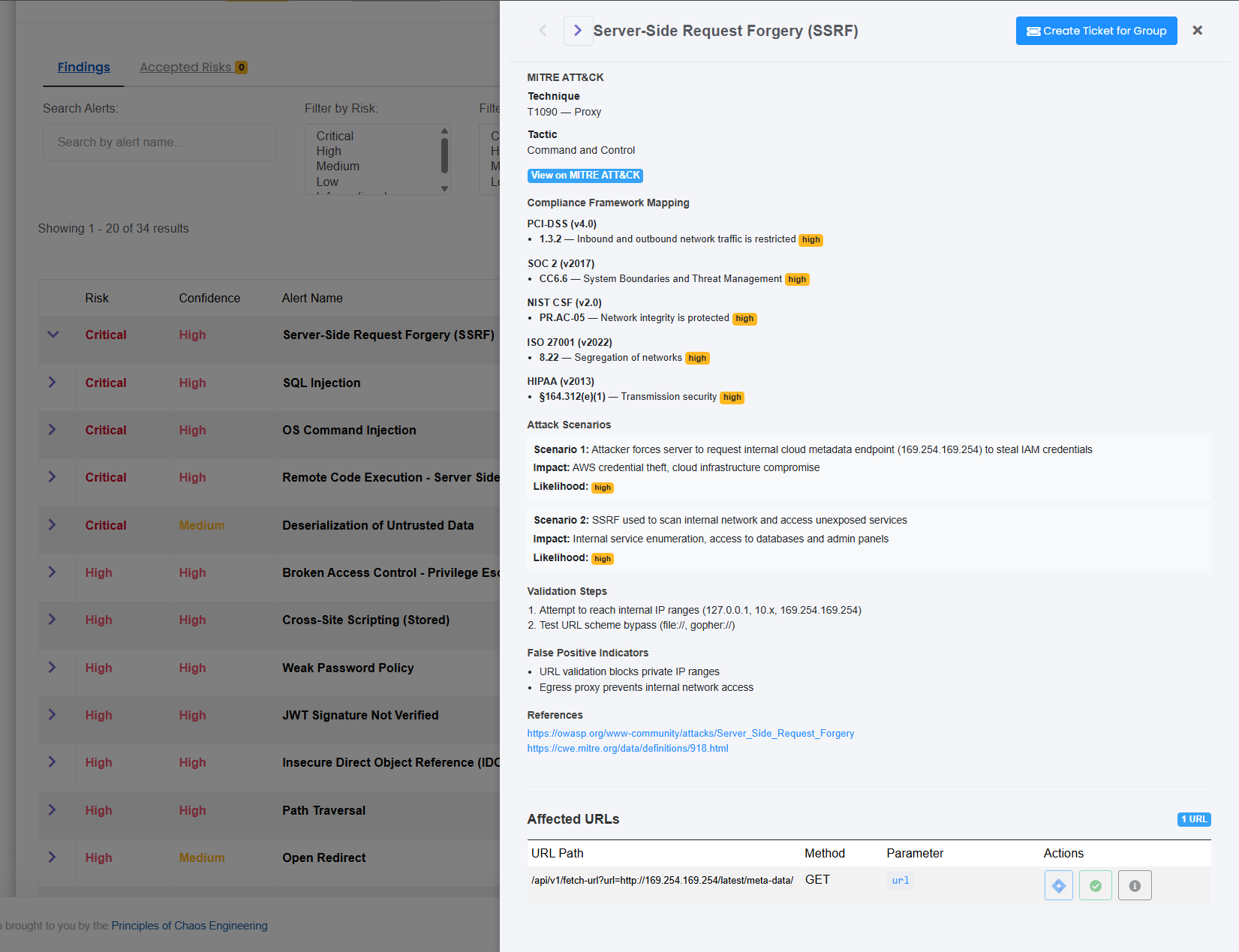
- 1**Crawl/Map:** Vortex automatically maps the entire attack surface (endpoints, APIs, auth flows, dependencies) on every deploy, ensuring up-to-date coverage.
- 2**Pentest:** It executes adversarial techniques (e.g., SQL injection, auth bypass, prompt injection) with live exploit chains, confirming vulnerabilities without false positives.
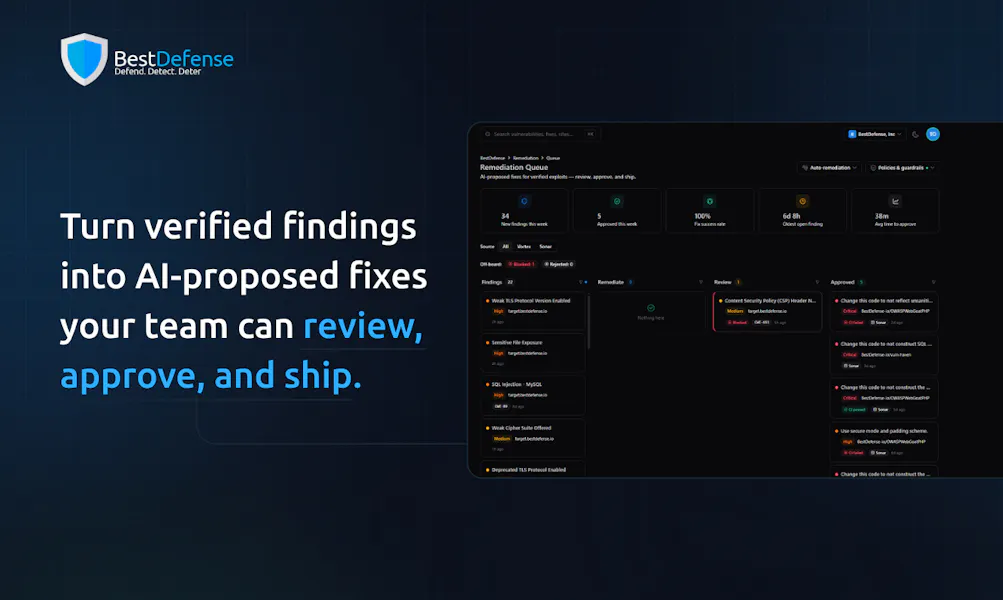
- 3**Fix:** For confirmed exploits, Vortex generates a stack-aware, production-ready pull request (PR) with the exact code change, blocking deployment until the fix is merged.
- 4**Retest/Verify:** The original exploit chain is re-executed against the patched build to confirm the vulnerability is resolved and prevent regressions.
- 5**Prove/Proof:** Every closed loop generates a timestamped proof record, automatically mapped to compliance frameworks like SOC 2, NIST, ISO 27001, and CMMC for one-click audit reports.
Real-World Use Cases
Automated CI/CD Security Gate
Continuous Compliance Reporting
Rapid Vulnerability Remediation
Privacy & Technical Details
- Utilizes 'Graph-native analysis' to model code as a 'Code Property Graph' for precise vulnerability identification.
- Leverages AI (LLMs) to generate stack-aware, production-ready code patches for confirmed exploits.
- Employs graph reconstruction to prove that all tainted paths are closed after a fix, ensuring patch effectiveness.
- Integrates directly into developer workflows via GitHub, GitLab, Jira, and Jenkins, processing code and deployment data within the CI/CD pipeline.
- Generates timestamped proof records for compliance, automatically mapped to SOC 2, NIST, ISO 27001, PCI DSS, and CMMC.
Pricing
BestDefense.io does not publicly list its pricing tiers on its official website. Interested organizations are directed to contact their sales team for a personalized quote. This approach is common for enterprise-grade security solutions, where pricing is often tailored based on the scale of operations, number of repositories, deployment frequency, and specific compliance needs.
Honest Pros & Cons
Pros
- • Automated Remediation: Generates production-ready pull requests with code fixes, significantly reducing Mean Time To Remediation (MTTR).
- • Zero False Positives: Confirms vulnerabilities with live exploit chains, ensuring only real issues are reported, saving developer time.
- • Continuous Compliance: Automatically generates audit-ready proof records mapped to major compliance frameworks (SOC 2, NIST, ISO 27001) for one-click reporting.
- • Developer-Native Integration: Seamlessly fits into existing CI/CD pipelines and developer tools like GitHub, GitLab, and Jira, minimizing workflow disruption.
- • Comprehensive Coverage: Maps the entire attack surface on every deploy, ensuring no blind spots and continuous security validation.
- • Root Cause Analysis: Clusters duplicate symptoms to identify and fix shared root causes, improving overall security posture and efficiency.
Cons
- • Black Box Nature: As an AI-driven automated system, understanding the exact logic behind vulnerability identification and fix generation might require a level of trust in the platform's AI.
- • Customization Limitations: While stack-aware, highly bespoke or complex architectural patterns might require manual oversight or fine-tuning beyond automated capabilities.
- • Initial Setup Complexity: Integrating a comprehensive security validation system into existing large-scale, complex CI/CD environments could require significant initial effort.
- • Dependency on AI Accuracy: The effectiveness relies heavily on the AI's ability to accurately identify vulnerabilities and generate correct, non-breaking fixes.
- • Pricing Opacity: Lack of transparent public pricing makes it difficult for smaller teams or those with budget constraints to quickly assess feasibility without direct engagement.
Comparison Table
| aspect | bestdefenseio | native | rewind | manual |
|---|---|---|---|---|
| Vulnerability Discovery | Automated crawl, AI-driven pentest with live exploit chains on every deploy. | Static (SAST) scans code for patterns; Dynamic (DAST) scans running app for known vulnerabilities. | Monitors runtime behavior for anomalies, often post-deployment. | Human experts manually probe applications, using their knowledge and tools. |
| Remediation | AI-generated, stack-aware PRs with code fixes, CI/CD gate enforcement. | Reports vulnerabilities, often with remediation advice, but requires manual developer action to fix. | Alerts to issues, but fixing is entirely manual. | Reports with detailed findings and recommendations; fixing is manual. |
| False Positives | Zero false positives due to live exploit chain verification. | Can have high rates of false positives, requiring manual triage. | Lower false positives for runtime issues, but might miss pre-deployment flaws. | Very low false positives due to human intelligence, but still possible. |
| Compliance & Proof | Automated, timestamped proof records mapped to SOC 2, NIST, ISO 27001, etc., for 1-click audit reports. | Generates reports, but mapping to compliance frameworks and evidence collection is largely manual. | Provides logs and traces, but requires manual effort to compile for compliance. | Produces detailed reports, but ongoing evidence collection for continuous compliance is manual. |
| Integration into CI/CD | Deep integration, blocking deploys, generating PRs within developer workflows (GitHub, GitLab). | Integrates as a scan step, often requiring separate tools or configurations. | Primarily for post-deployment monitoring, less direct CI/CD integration for blocking. | Outside the CI/CD pipeline, typically scheduled as periodic engagements. |
Who Should Use BestDefense.io
BestDefense.io is ideal for fast-moving development teams, particularly in regulated industries or those handling sensitive data, who need to maintain a strong security posture without sacrificing deployment speed. Organizations with mature CI/CD pipelines looking to automate security validation, reduce security debt, and streamline compliance reporting will find significant value. It's especially suited for companies that want to shift security left, integrating it seamlessly into every commit and deploy.
Who Should Skip
Smaller teams or startups with very limited budgets and simpler applications might find BestDefense.io to be an overkill, especially given the likely enterprise-level pricing. Teams that prefer full manual control over every aspect of their security testing, or those with highly unconventional development practices that might not align with automated tooling, might also find it less suitable. Organizations not yet ready for a continuous deployment model might not fully leverage its benefits.
Our take
Worth testing
BestDefense.io presents a compelling vision for the future of application security, moving beyond mere vulnerability detection to automated, verified remediation. By integrating AI-powered pentesting and patching directly into the CI/CD pipeline, BestDefense.io promises to significantly reduce security risks, accelerate development cycles, and simplify compliance. Its commitment to zero false positives and one-click audit reports addresses major pain points for modern DevSecOps teams. While the lack of transparent pricing and the inherent 'black box' nature of advanced AI systems might be considerations, for organizations committed to continuous security and compliance at scale, BestDefense.Defense.io offers a robust and innovative solution that could redefine their security operations.
Current status: no tracked affiliate for BestDefense.io. This review is independent and not sponsored. We update this as programs become available (PartnerStack, Impact, etc).